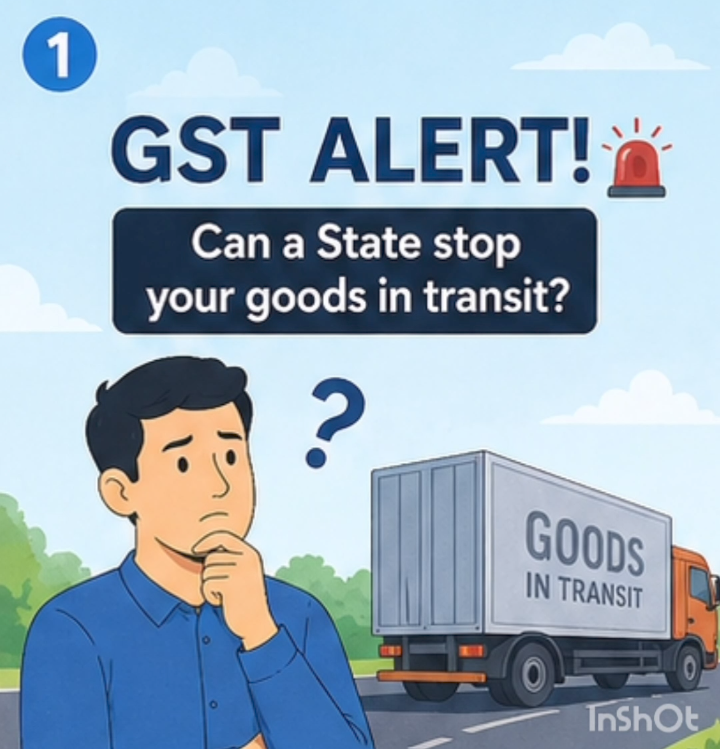
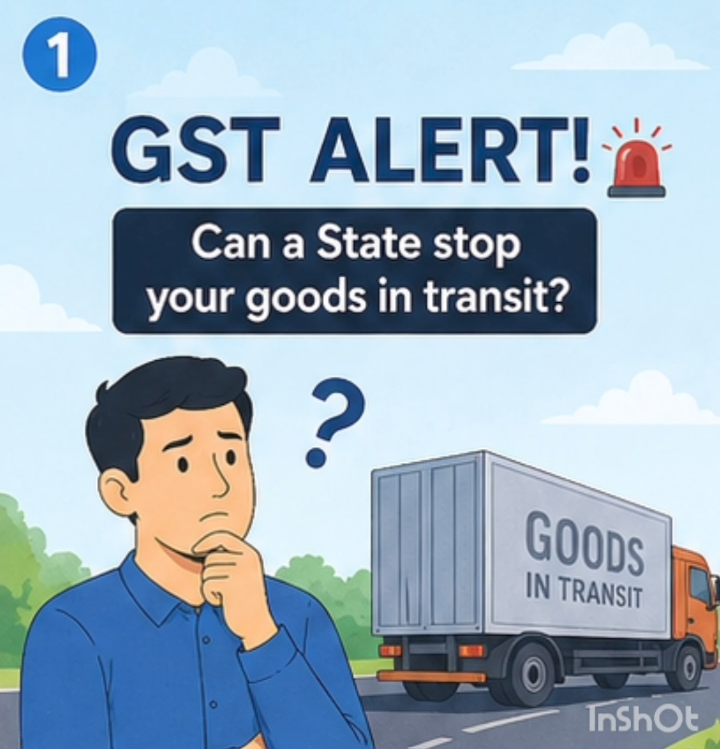
A significant question arising under the GST regime is whether authorities of a State functioning merely as a transit corridor possess jurisdiction to detain goods and impose penalties under Section 129 of the Central Goods and Services Tax Act, 2017 ("CGST Act") where the underlying supply neither originates nor terminates within that State. The controversy assumes particular importance in cases where goods move from one State to another and merely passed through Uttar Pradesh without creating any tax incidence within the State.
The recent judicial approach suggests that GST enforcement powers are not unbridled and must operate within the framework of territorial nexus and tax jurisdiction. Where no tax liability accrues to the transit State and the transaction is otherwise genuine, invocation of detention and penalty provisions merely because the conveyance traverses that State raises serious constitutional and statutory concerns. The issue goes to the heart of federal fiscal powers under the GST architecture and the limits of enforcement jurisdiction.
Background and Legislative Context
The GST framework introduced through the Constitution (One Hundred and First Amendment) Act, 2016 was designed to facilitate seamless movement of goods across State boundaries while eliminating cascading taxes and multiple checkpoints. The constitutional scheme embodied in Articles 246A, 269A and 286 recognizes inter-State supplies as a distinct taxable event, with Integrated GST (IGST) being levied and apportioned in accordance with constitutional principles.
To ensure smooth transportation of goods, the legislature introduced the e-way bill mechanism under Section 68 of the CGST Act read with Rule 138 of the CGST Rules, 2017. The objective was preventive rather than punitive, enabling authorities to verify movement of goods and curb tax evasion.
Section 129 of the CGST Act empowers detention, seizure and release of goods and conveyances in transit where transportation is undertaken in contravention of the Act or Rules. However, the provision was never intended to operate as a revenue-generating measure or as a tool to penalize every procedural lapse. The legislative intent is to prevent tax evasion and protect legitimate revenue interests.
The question therefore arises whether a State through which goods merely pass can invoke Section 129 despite having no nexus with the underlying taxable supply.
The Core Controversy
The controversy emerges where goods are transported from one State to another and, during transit, enter Uttar Pradesh solely because of geographical routing. GST authorities in Uttar Pradesh detect alleged discrepancies in documentation and proceed to detain the goods under Section 129.
The critical legal issue is whether a transit State can exercise penal jurisdiction when:
- The supplier is located outside Uttar Pradesh;
- The recipient is located outside Uttar Pradesh;
- The place of supply is outside Uttar Pradesh;
- No GST revenue is payable to Uttar Pradesh; and
- The State's only connection with the transaction is that the vehicle temporarily passed through its territory.
In essence, the dispute concerns the extent of territorial jurisdiction of GST enforcement authorities vis-à-vis inter-State supplies governed by the IGST framework.
Territorial Nexus Under the GST Constitutional Framework
The GST regime is founded upon the concept that taxing powers must correspond with a taxable event and territorial nexus. Under Article 269A of the Constitution, GST on inter-State supplies is levied and collected by the Union, with apportionment between the Centre and destination State.
A transit State neither receives tax revenue nor possesses any substantive connection with the supply. Consequently, any assertion of penal jurisdiction by such State must be tested against constitutional principles governing legislative competence and territorial nexus.
The Supreme Court has consistently held that jurisdictional powers must have a real and substantial connection with the subject matter sought to be regulated. Although GST officers are empowered to inspect goods in transit, such powers cannot be interpreted so broadly as to permit a transit State to effectively adjudicate transactions having no fiscal nexus with it.
A contrary interpretation would undermine the destination-based nature of GST and revive the very barriers to trade that the GST regime sought to abolish.
Scope and Limits of Section 129
Section 129 authorizes detention only where goods are transported "in contravention of the provisions of this Act or the rules made thereunder."
Judicial interpretation across several High Courts has progressively clarified that detention cannot be justified merely on account of technical or clerical errors when there is no evidence of tax evasion.
The Supreme Court in Assistant Commissioner (ST) v. Satyam Shivam Papers Pvt. Ltd. Dated 12-01-2022 [(2022) 57 GSTL 163 (SC)] emphasized that the purpose of detention provisions is to address genuine violations impacting tax administration rather than to punish every procedural irregularity.
Likewise, High Courts have repeatedly distinguished between substantive tax evasion and technical documentation defects. The settled position emerging from these decisions is that the existence of mens rea or circumstances indicative of revenue loss remains a relevant consideration while invoking penal provisions.
Where goods are moving pursuant to a genuine inter-State transaction and no tax is payable in the transit State, the foundational rationale for detention becomes considerably weaker.
Judicial Recognition of the Transit State Limitation
The jurisprudence has increasingly recognized that GST authorities cannot exercise powers divorced from the revenue implications of the transaction.
Particularly relevant is the reasoning adopted by the Allahabad High Court in recent decisions, including M/s Maruti Enterprises Vs State of U.P. and another [WRIT TAX No. - 1423 of 2026] and connected matters. The Court examined situations where goods originating outside Uttar Pradesh and destined outside Uttar Pradesh were intercepted solely because they passed through the State.
The Court observed that Uttar Pradesh authorities were effectively acting as authorities of a transit State. Since the transactions neither originated nor concluded within Uttar Pradesh and no tax liability accrued to the State, invocation of Section 129 solely on account of documentation issues was held to be legally unsustainable.
The Division Bench underscored that GST enforcement powers must be exercised in a manner consistent with the constitutional structure of destination-based taxation. A transit State cannot assume a role equivalent to that of the jurisdictional State possessing substantive nexus with the supply.
The judgment therefore represents an important affirmation of federal balance within the GST framework.
Competing Revenue Perspective
Revenue authorities often argue that Section 68 and Section 129 confer pan-India powers of interception and verification. According to this view, every GST officer is authorized to examine documents accompanying goods and initiate proceedings wherever violations are detected.
While this proposition may be correct to the extent of inspection and verification, the more difficult question concerns the imposition of penalties where the alleged contravention has no revenue implications for the intercepting State.
An expansive interpretation would enable every transit State to initiate independent proceedings on transactions wholly unconnected with it. Such an approach risks creating overlapping jurisdictions, inconsistent outcomes and significant compliance burdens for taxpayers engaged in inter-State commerce.
Moreover, it would be inconsistent with the objective of creating a unified national market under GST.
Impact on Businesses and Ongoing Litigation
The legal position emerging from recent judicial pronouncements provides significant relief to businesses engaged in long-distance transportation of goods.
First, it curtails the tendency of transit-State authorities to invoke Section 129 for minor procedural lapses disconnected from tax evasion.
Second, it reinforces the principle that enforcement action must bear a reasonable nexus with the taxable event and the State's revenue interest.
Third, the rulings strengthen certainty in supply chain management by reducing the risk of arbitrary detention during inter-State movement.
For pending disputes, taxpayers may rely on the constitutional principles of territorial nexus, destination-based taxation and proportional exercise of statutory powers to challenge detention orders issued by transit-State authorities.
The decisions may also influence future adjudication involving e-way bill discrepancies, route deviations and documentation errors where no revenue loss is demonstrated.
Conclusion and Way Forward
The GST framework was conceived as a destination-based tax system designed to facilitate, rather than obstruct, the free movement of goods across India. While authorities undoubtedly possess powers to inspect and verify goods in transit, such powers cannot be stretched to confer unrestricted penal jurisdiction upon a State that has no substantive connection with the underlying transaction.
The emerging judicial consensus, particularly reflected in the Allahabad High Court's recent Division Bench ruling, supports the proposition that a mere transit State cannot invoke Section 129 to impose penalties on inter-State transactions that neither originate nor terminate within its territory, absent demonstrable tax evasion or revenue implications.
Going forward, taxpayers facing detention by transit-State authorities should carefully examine whether the impugned proceedings satisfy the requirements of territorial nexus, statutory purpose and constitutional proportionality. Equally, GST administrations would benefit from issuing clear administrative guidelines to ensure that enforcement powers are exercised consistently with the destination-based architecture of the GST regime, thereby preserving both revenue interests and the constitutional promise of a seamless national market.