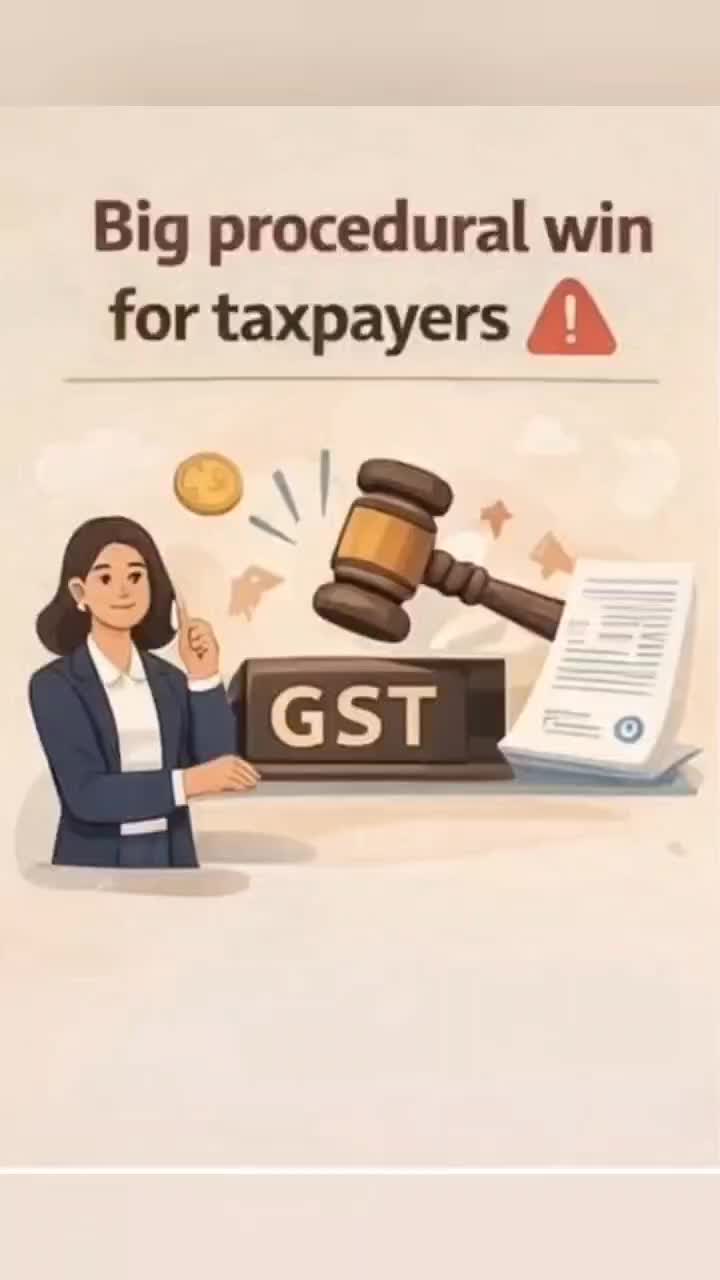
The GST regime was envisaged as a technology-driven tax system, but technology cannot eclipse statutory safeguards. In a significant reaffirmation of this principle, the Gauhati High Court in M/s Sarada Refrigeration and Air Condition v. State of Assam (WP(C)/2345/2026 decided on 17 June 2026) has held that a summary of a show cause notice in Form GST DRC-01 cannot substitute the statutory show cause notice mandated under Section 73(1) of the GST Act. While quashing the adjudication order founded on such defective proceedings, the Court simultaneously safeguarded the interests of the Revenue by permitting fresh proceedings and excluding the intervening period from the computation of limitation. The ruling reiterates that procedural compliance is not a mere technicality but the foundation of fair adjudication under the GST framework.
Background of the Dispute
The petitioner challenged the validity of the proceedings initiated under Section 73 of the Assam Goods and Services Tax Act, 2017. The grievance was straightforward yet fundamental: the department had issued only the summary of the show cause notice in Form GST DRC-01, followed by an Order-in-Original, without serving the statutory show cause notice contemplated under Section 73(1). According to the petitioner, Rule 142 of the GST Rules merely prescribes issuance of a summary in Form DRC-01 after the statutory notice is issued and cannot dispense with the statutory requirement itself.
The Revenue fairly conceded that the controversy stood covered by the earlier decision of the Gauhati High Court in Construction Catalysers Pvt. Ltd. (WP(C)/3912/2024, WP(C)/4619/2024, WP(C)/3933/2024, WP(C)/4379/2024, WP(C)/4618/2024, WP(C)/3910/2024 decided on 26 September 2024), though it urged the Court to preserve limitation if the proceedings were set aside on account of what it described as a technical lapse.
A Summary Cannot Replace a Statutory Notice
The High Court relied extensively upon its earlier decision in Construction Catalysers Pvt. Ltd., where it had undertaken a detailed examination of the statutory scheme governing demand proceedings under Section 73.
The Court reiterated that the GST legislation consciously distinguishes between three different documents, the show cause notice under Section 73(1), the statement under Section 73(3), and the summary required to be uploaded electronically in Form GST DRC-01 under Rule 142. Each serves a distinct statutory purpose. The summary is only an electronic synopsis intended to facilitate digital administration; it is not the statutory notice that sets the adjudicatory process in motion.
Treating the attachment accompanying Form DRC-01 as the show cause notice would, according to the Court, defeat the plain language of Section 73 and render the statutory safeguards illusory. The show cause notice must itself communicate the allegations, the factual basis of the proposed demand, and the legal provisions invoked so that the taxpayer is afforded an effective opportunity to respond before any liability is determined.
The judgment thus reinforces a settled principle of administrative law,that where a statute prescribes a particular procedure before adverse action is taken, that procedure must be followed in both letter and spirit.
Authentication by the Proper Officer: Not a Mere Formality
Another important facet of the judgment concerns the authentication of statutory notices and orders.
The Court reiterated that the power to issue a show cause notice and pass an adjudication order is vested exclusively in the "Proper Officer". Consequently, every statutory notice and order must carry the authentication of that officer. Referring to Rule 26(3) of the GST Rules and the decisions of the Telangana, Andhra Pradesh and Delhi High Courts, the Court observed that digital authentication is not an empty procedural ritual but an indispensable requirement that establishes the legal validity of official action.
Although Rule 26(3) expressly applies to Chapter III of the Rules, the Court noted the absence of a corresponding provision governing Chapter XVIII dealing with demand and recovery. Until such legislative or executive clarification is made, the Court held that the principle embodied in Rule 26(3) should equally govern demand proceedings to ensure that notices and orders are properly authenticated by the competent authority.
The ruling therefore fills an important procedural vacuum while ensuring that the integrity of electronic adjudication is preserved.
Balancing Procedural Fairness with Revenue Interests
The Court consciously refrained from allowing procedural defects to permanently extinguish legitimate tax proceedings.
Instead of merely quashing the adjudication order, it granted liberty to the department to issue a fresh show cause notice under Section 73(1). More importantly, it directed that the fresh notice would relate back to the date on which the original summary in Form DRC-01 had been issued. The Court also ordered that the period between issuance of the summary and service of the judgment upon the Proper Officer would stand excluded while computing the limitation prescribed under Section 73(10) for passing the adjudication order.
This pragmatic approach reflects an important judicial balance. While taxpayers cannot be subjected to adjudication without compliance with mandatory statutory safeguards, procedural lapses arising from an erroneous understanding of the law should not necessarily deprive the Revenue of the opportunity to proceed afresh where the substantive claim survives.
Significance of the Ruling
The decision has implications extending beyond the facts of the individual case.
First, it strengthens the growing body of judicial precedent holding that Form GST DRC-01 is only a summary and not the show cause notice itself. The judgment reinforces that Rule 142 operates as a procedural aid and cannot override the substantive requirement contained in Section 73.
Secondly, it underscores that procedural safeguards are jurisdictional in nature. The validity of an adjudication does not depend solely on the correctness of the tax demand but also upon the legality of the process adopted. Where proceedings commence without a valid statutory notice, the entire adjudicatory exercise is liable to fail irrespective of the merits of the underlying demand.
Thirdly, the judgment serves as an important reminder for tax administrations to ensure that electronic governance does not become a substitute for statutory compliance. Automated generation of summaries through the GST portal cannot compensate for the absence of a legally valid show cause notice or proper authentication by the competent authority.
Finally, by protecting the limitation period while directing de novo proceedings, the Court has adopted a balanced approach that advances both taxpayer rights and effective tax administration.
Conclusion
The Gauhati High Court's decision in Sarada Refrigeration and Air Condition is another important addition to the evolving jurisprudence on procedural safeguards under GST. It reiterates that the architecture of Section 73 is built upon a valid show cause notice, and that the statutory requirement cannot be diluted by relying solely on electronically generated summaries in Form GST DRC-01. Equally significant is the Court's insistence that statutory notices and orders must bear proper authentication by the Proper Officer, reinforcing accountability in electronic tax administration.
Perhaps the most noteworthy aspect of the ruling is its balanced approach. Rather than treating the procedural lapse as fatal to the Revenue, the Court preserved the department's right to recommence proceedings while ensuring that taxpayers receive the procedural protections guaranteed by law. As GST litigation increasingly focuses on procedural compliance, this judgment serves as a timely reminder that digital convenience can facilitate tax administration, but it cannot replace statutory due process.